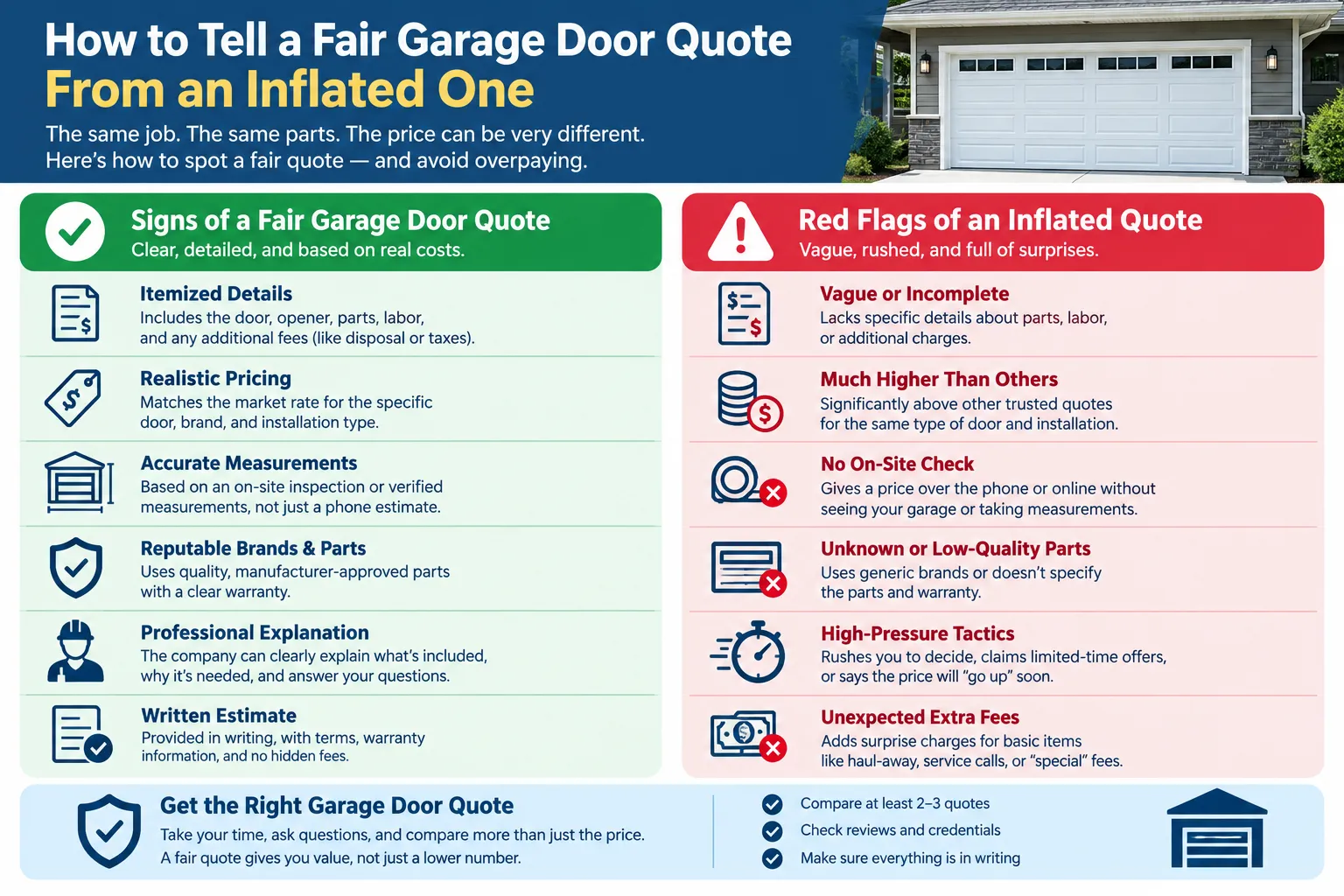
A fair garage door quote separates labor, hardware, and warranty terms into figures a homeowner can actually check, while an inflated one hides everything behind a single rushed total. Requesting a garage door replacement often puts homeowners at this exact fork in the road before any wrench touches the track.
Price alone rarely tells the full story, since two companies can quote wildly different totals for the same job and still both be reasonable. This guide breaks down what a fair quote includes, the red flags that signal an inflated one, and the steps to take before any money changes hands.
Key Takeaways
- Fair quotes itemize labor, hardware, and haul-away costs separately.
- Vague pricing and rushed timelines are the two most common signs of inflation.
- Vetting a company before the estimate call prevents most scam attempts.
- Comparing multiple written quotes quickly exposes pricing outliers.
- Reporting a suspicious quote protects other homeowners in the area.
How to Vet a Company Before Requesting a Quote
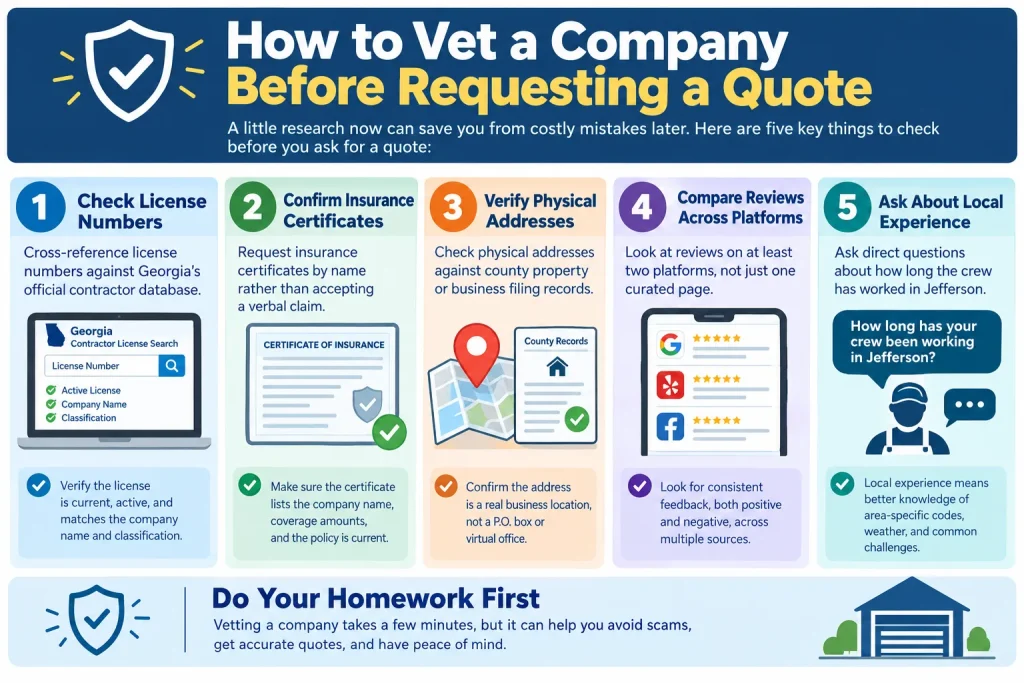
Background checks completed before the first estimate call are what separate homeowners who avoid pricing problems from those who run into them later.
This groundwork usually includes:
- License numbers cross-referenced against Georgia’s official contractor database.
- Insurance certificates requested by name rather than accepted as a verbal claim.
- Physical addresses checked against county property or business filing records.
- Reviews compared across at least two platforms, not just one curated page.
- Ask direct questions about how long the crew has worked in Jefferson.
To cover the exact questions to ask and documents to request, read our guide on How to Choose a Trustworthy Garage Door Company to Quote, which breaks down exactly what to confirm before letting anyone measure the door.
What Does a Fair Garage Door Quote Typically Include?
Legitimate estimates read like a line-by-line breakdown a homeowner can check, not a single number to accept on faith.
This structure usually includes:
- Hardware, labor, and haul-away fees priced out as three separate figures.
- Exact panel width and height paired with steel gauge or insulation R-value.
- A start-to-finish timeline covering measurement through final garage door installation.
- Warranty terms specifying coverage length for parts separately from labor.
- A named project contact reachable by direct phone line, not a shared call center.
Estimates built this way rarely need explaining twice, since every figure already answers the question a homeowner would otherwise have to ask.
Signs of a Fair Quote vs. Red Flags of an Inflated One
Pricing structure often reveals a company’s true intentions, since honest and inflated estimates follow different logic from the start.
Category | Fair Quote Signal | Inflated Quote Red Flag |
Line Items | Hardware, labor, and haul-away costs listed separately | A single lump sum with no breakdown |
Scope | Exact dimensions, material quality, and brand names specified | Generic terms like “parts and labor” only |
Payment Terms | Milestone or completion-based payment | Full cash payment demanded upfront |
Warranty | Written guarantee on parts and labor, typically 1 to 2 years | No warranty mentioned or offered verbally only |
Pricing Behavior | Estimate holds steady once work begins | “Required” replacements appear after arrival |
Company Presence | Verifiable local address and branded vehicle | No physical address or an unmarked vehicle |
Confidence in pricing shows in the willingness to avoid overcharging, while vague totals usually protect a company from that same scrutiny.
Signs of a Fair Quote
Detailed Line Items
Separate figures for hardware, labor, and disposal give a homeowner something concrete to compare, instead of one number hiding how it was calculated.
These line items should appear on any itemized estimate:
- Spring cycle rating and opener model number written out by name.
- Labor priced as hours multiplied by a stated hourly or flat rate.
- Disposal of the old door billed as its own separate charge.
- Permit or inspection costs broken out from the general labor total.
- A pre-tax subtotal matching the sum of every line item above it.
Breaking a quote into these individual figures gives a homeowner leverage to question any single line without disputing the entire job.
Transparent Scope
Exact measurements and named material grades tell a homeowner precisely what they are paying for, instead of leaving specifics open to interpretation later.
Transparent scope typically states the following:
- Width and height measured in inches rather than rounded to the nearest foot.
- Steel gauge or panel insulation R-value written directly on the estimate.
- List the brand and model number for any replacement garage door opener.
- Confirm color, finish, and hardware style in writing before ordering.
- Added cost for custom sizing broken out as its own separate line.
Specificity at this level removes the room a company would otherwise need to justify a higher bill after installation begins.
Milestone Payments
Tying payment to project stages keeps the homeowner in control instead of handing over full control the moment a deposit clears.
Fair payment structures usually look like this:
- Cap the deposit at roughly a third of the total project cost.
- Release a second payment only once materials arrive on site.
- Final balance due strictly after installation passes a walkthrough.
- Refund terms written out in case the job gets canceled early.
- Accept cards or checks as an alternative to a cash-only demand.
Spreading payment across these stages keeps a homeowner in a position to withhold funds if the work does not match what was promised.
Clear Warranties
Written warranty terms give a homeowner a real document to point to if hardware fails months after the crew has already left.
Clear warranty terms should include the following:
- A minimum one- to two year coverage window stated for parts.
- Labor warranty period listed as its own separate coverage term.
- Attach manufacturer warranty details for the garage door opener itself.
- Include step-by-step claim instructions in case something fails.
- Hand over a signed copy on-site, not promised later by email.
Real recourse exists for a garage door spring or panel failure within the coverage period, unlike a promise that was only ever spoken.
Red Flags of an Inflated Quote
Dishonest pricing tends to fall apart under the same scrutiny a fair quote can withstand, since it was never built to survive close questions in the first place.
Watch for these four patterns during any estimate call:
- No itemized breakdown offered behind a single flat total.
- A signature requested before the technician leaves the driveway.
- Phone quotes that jump significantly the moment the crew arrives.
- No verifiable address turning up under the company’s listed name.
- A written copy of the offer refused or repeatedly delayed.
Even one of these patterns showing up during an estimate call is reason enough to get a second opinion before any money changes hands.
Vague Descriptions
Generic phrasing like “parts and labor” leaves a homeowner with no way to check whether the total actually reflects the job in front of them.
Vague pricing usually shows up in these forms:
- A single number presented with zero itemization behind it.
- No part names, model numbers, or hourly rates listed anywhere.
- Labor and materials folded into one unexplained combined figure.
- A written explanation refused once you question the total.
- A verbal quote given over the phone but never put in writing.
Confident pricing rarely needs to hide behind vague totals, since a company that stands behind its numbers has nothing to gain by withholding the math.
High-Pressure Tactics
Manufactured urgency in the sales pitch exists to lock in a signature before a homeowner has time to compare the offer with anything else.
These pressure tactics show up often during in-home estimates:
- A discount offered only if the contract gets signed immediately.
- Claims that the door could fail completely within a day or two.
- Withholding a written copy of the offer until after signing.
- Comments discouraging a homeowner from calling other companies first.
- Repeated follow-up calls pushing hard for a same-day decision.
Real offers hold their price for at least a few days, since legitimate businesses expect homeowners to compare bids before committing.
Bait-and-Switch Pricing
An unrealistically low quoted price over the phone often exists purely to get a technician through the front door and into a negotiation.
Bait-and-switch behavior tends to follow this pattern:
- An advertised service call fee set well below the local average cost.
- New “required” repairs discovered only once the technician arrives.
- A final bill landing several times higher than the original phone quote.
- Claims that the original number “didn’t include” basic labor charges.
- They demand immediate approval before explaining the new total.
Phone quotes that survive contact with the actual technician strongly suggest the company priced the job honestly from the start.
No Physical Presence
Companies with no verifiable location or branding become far harder to hold accountable once something goes wrong after payment.
Confirm a company’s physical presence through these checks:
- A street address matching a real building instead of a P.O. box.
- A branded vehicle with a visible logo instead of a plain truck.
- A uniform or visible identification worn by the technician on-site.
- A landline listed separately from a personal cell phone number.
- Business registration confirmed through the Georgia Secretary of State site.
Missing every one of these details usually points to a crew with nothing tying them to the area beyond the appointment itself.
What to Do When a Quote Seems Inflated?
The first response to a suspicious quote tends to shape everything that follows, long before any conversation about the actual dollar amount begins.
Take these steps before agreeing to anything:
- Declining to sign or pay anything before the total gets reviewed.
- Comparing the quoted labor rate against typical repair costs for the area.
- Searching the company name alongside terms like “complaint” or “review.”
- Requesting a written explanation for every single disputed line item.
- Scheduling a second estimate before approving any part of the work.
To walk through a full response plan once pricing looks off, read our guide on What to Do When a Garage Door Quote Seems Too High?, which covers how to push back calmly without losing leverage or paying more than the job is worth.
How to Report a Suspicious Garage Door Quote
Filing a report on a suspicious quote does more than resolve one bad estimate, since it also flags the company before another homeowner in the area gets the same treatment.
File a report using these steps:
- A complaint submitted through the Georgia Governor’s Office of Consumer Protection.
- A review and complaint filed directly with the Better Business Bureau.
- Report the license number to the state contractor licensing board.
- Copies saved of the written quote, along with any texts or emails.
- Contact local police for cases involving emergency garage door repair calls billed but never completed.
Investigators can act on a documented complaint far more effectively than an unverified one, which makes saved records worth keeping from the very first phone call.
How to Protect Yourself From Future Inflated Quotes

Long-term protection comes down to habits that make padded pricing harder to slip past a homeowner the next time a repair comes up.
Build these habits into every future estimate request:
- Collect at least three written quotes before making any decision.
- Store past estimates and invoices together in one labeled folder.
- Check license status and reviews before scheduling the first call.
- Schedule regular maintenance instead of waiting for a full failure.
- Companies chosen specifically for their willingness to put promises in writing.
To compare multiple bids the right way without falling for a repeat of the same tactics, read our guide on How to Compare Garage Door Quotes Without Getting Scammed, which walks through exactly how to line up offers side by side.
Detail in Writing Is What Makes a Garage Door Quote Fair
Pricing alone rarely separates an honest garage door company from a dishonest one, since the real signal sits in how much detail a company puts in writing before work begins. Insisting on itemized estimates and written warranties helps homeowners avoid inflated bills that catch everyone else off guard.
C&C Garage Door and Opener LLC works with homeowners throughout Jefferson, Georgia, helping them spot a fair quote from an inflated one before signing any contract. Contact us or give us a call today, and let our team walk you through a written, itemized estimate before you commit to anything.