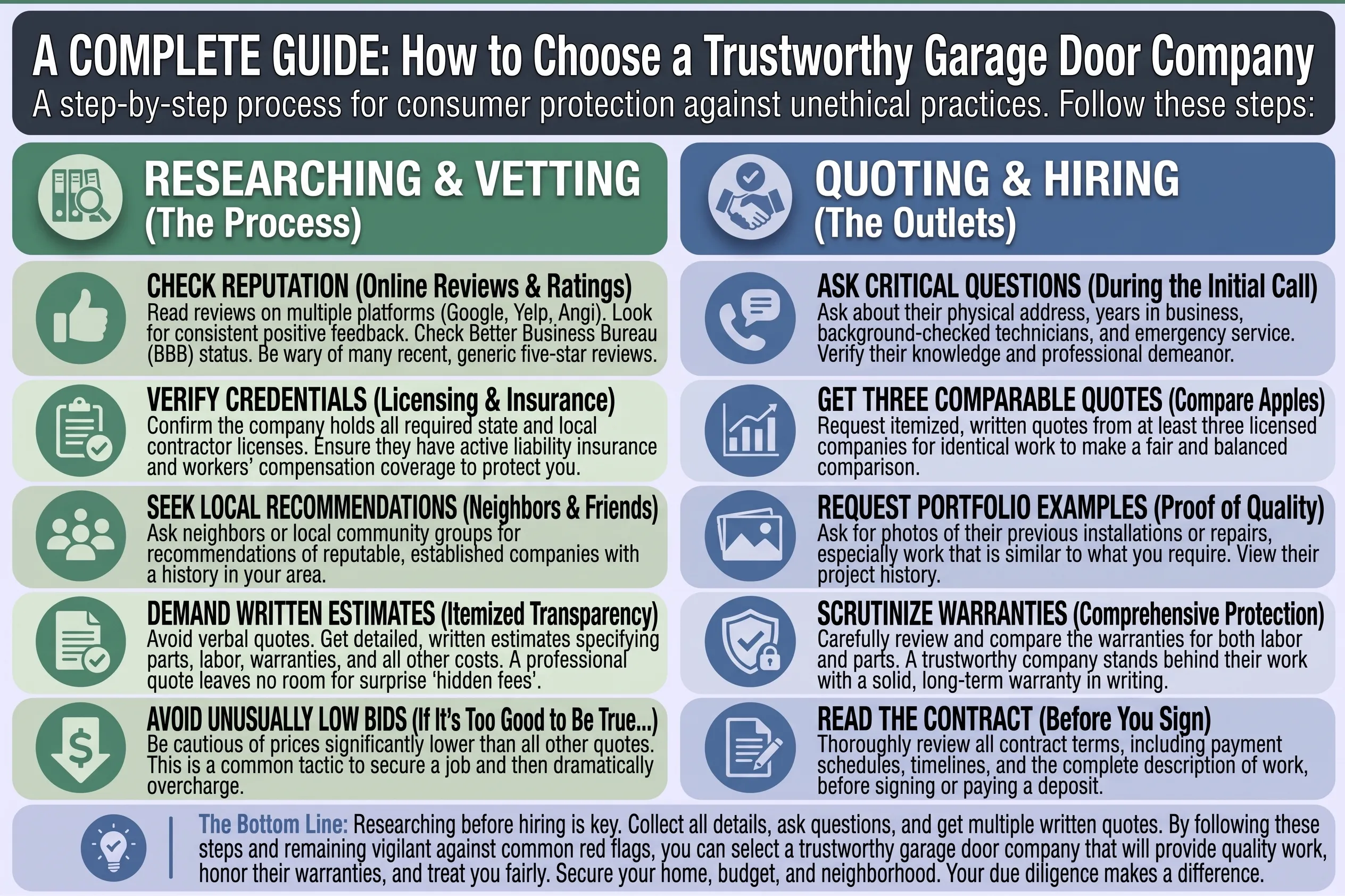
Choosing a trustworthy garage door company starts with confirming licensing, insurance, reviews, and pricing habits well before anyone measures the door. A homeowner who never checks these details has no reliable way to verify who they let onto the property, whether the job is a simple repair or a full garage door replacement.
Vetting takes only a few extra minutes but prevents most of the pricing disputes and unexpected charges that show up weeks later once the work is already done. This guide walks through exactly what to check before requesting a quote and what separates a real local business from an operator with nothing to lose.
Key Takeaways
- Licensing and insurance protect homeowners if a worker gets hurt or causes damage.
- A real physical address rules out companies hiding behind a shifting local presence.
- Independent reviews reveal patterns a single rating never shows on its own.
- Written quotes from multiple companies establish a fair price before any commitment.
- Warranty terms in writing give homeowners real recourse if a repair fails later.
How to Vet a Garage Door Company Before Requesting a Quote
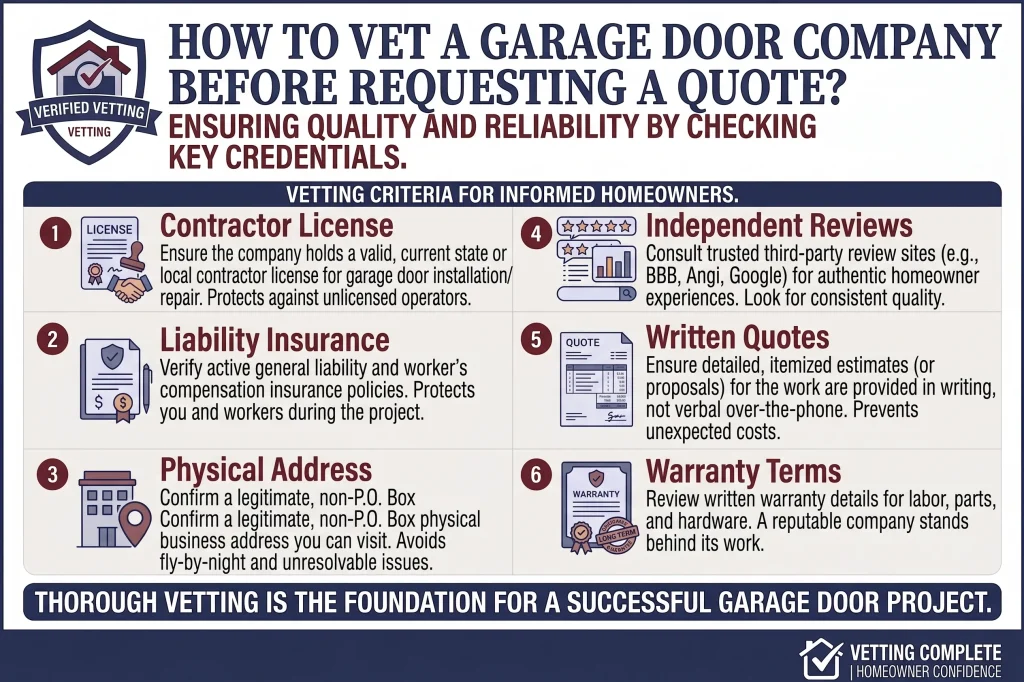
Verification habits separate homeowners who avoid inflated pricing from those who discover problems only after signing.
What to Verify | How to Check It | What It Protects Against |
Contractor License | State licensing board database | Unlicensed work with no legal recourse |
Liability Insurance | Certificate requested by name | Homeowner liability for job-site accidents |
Physical Address | County property or business filing records | Out-of-area operators using a local front |
Independent Reviews | Google, Yelp, and Better Business Bureau | Inflated pricing hidden behind a single rating |
Written Quotes | Itemized estimate from each company contacted | Verbal promises with no pricing accountability |
Warranty Terms | Coverage length documented in writing | No recourse if hardware fails after installation |
A company willing to document its licensing openly, without being asked twice, has nothing left to hide once the estimate call actually happens.
Check Licensing and Insurance
Licensing and insurance confirm a garage door repair company operates legally and carries real accountability if something goes wrong during the job.
Verify these details before scheduling any appointment:
- Contractor license number cross-checked against Georgia’s state database.
- Liability insurance certificate requested by name, not accepted verbally.
- Workers’ compensation coverage confirmed for any technician on-site.
- License status checked for active standing, not expired or pending.
- Direct questions asked about individual technician certification.
A company able to produce both documents on request without delay has no real reason to avoid the conversation in the first place.
Look for a Local Physical Address
A verifiable street address separates an established local business from an operator hiding behind a shifting online presence.
Watch for these signs during the search:
- Physical office or warehouse confirmed at the listed address.
- Address searched on a map to rule out a P.O. box.
- Repeated business name changes tied to the same location.
- Years of operation confirmed at the current address.
- Local phone number verified as separate from an out-of-state call center.
An address that checks out consistently across every platform rarely belongs to a company planning to disappear after the first complaint.
Read Independent Reviews
Independent reviews reveal patterns of service quality that a single rating on one platform never fully captures.
Check these sources before booking an appointment:
- Reviews compared across Google, Yelp, and the Better Business Bureau.
- Repeated complaints noted about hidden fees or unfinished work.
- Company responses checked for professionalism on negative reviews.
- Review volume compared against how long the company claims to operate.
- Patterns flagged when reviews appear only on the company’s own site.
To compare pricing patterns the right way once the reviews check out, read our guide on How to Compare Garage Door Quotes Without Getting Scammed, which covers exactly how to line up multiple bids side by side.
Request Written Quotes From Multiple Companies
Written quotes from more than one company establish a realistic price range before any technician touches the door.
Follow these steps before agreeing to any work:
- Full itemized breakdown requested from at least three companies.
- Written quote requested before scheduling the actual visit.
- Consistency checked across repair costs and labor rates quoted.
- Phone estimates flagged if they shift once a technician arrives.
- Every quote saved in case a dispute comes up later.
To learn exactly how to judge whether any single quote is fair once these numbers come in, read our guide on How to Tell a Fair Garage Door Quote From an Inflated One, which breaks down the pricing signals worth checking line by line.
Understand Warranty Coverage
Written warranty terms confirm what recourse exists if the same issue returns after the crew has already left.
Confirm these details in writing before the technician leaves:
- Parts and labor coverage listed as two separate warranty terms.
- Specific coverage duration requested for each warranty type.
- Standard coverage length confirmed as at least one year.
- Warranty terms documented directly on the final invoice.
- Contact information provided for filing a future claim.
Regular garage door maintenance paired with documented warranty terms gives a homeowner real protection long after the installation crew has gone.
Watch for Vetting Red Flags
Specific behaviors during the vetting process reveal a company more interested in closing a sale than doing honest work.
Stay alert for these red flags throughout the process:
- Full payment demanded before any work has started.
- Simple repairs reframed as requiring a new garage door opener.
- High-pressure tactics used to rush an on-the-spot decision.
- Written estimates refused before scheduling the actual visit.
- Direct questions about licensing met with vague or evasive answers.
A company willing to answer every question directly and without hesitation has no real need to rely on pressure tactics to close the sale.
Making the Final Decision Before Requesting a Quote
A final decision holds up best once every vetting step has been confirmed and checked against scam patterns, since missing this stage undoes most of the earlier research.
Review this checklist one last time before booking:
- Licensing, insurance, and a verified physical address confirmed together.
- Feedback reviewed across at least two independent platforms.
- Written quotes compared from more than one local company.
- Warranty terms documented separately for parts and labor.
- Any last-minute pressure to skip these steps treated as a red flag.
To handle a quote that still looks off even after completing all of this research, read our guide on What to Do When a Garage Door Quote Seems Too High?, which covers how to push back calmly without losing leverage or paying more than necessary.
A Company Worth Hiring Is One That Passes Every Background Check
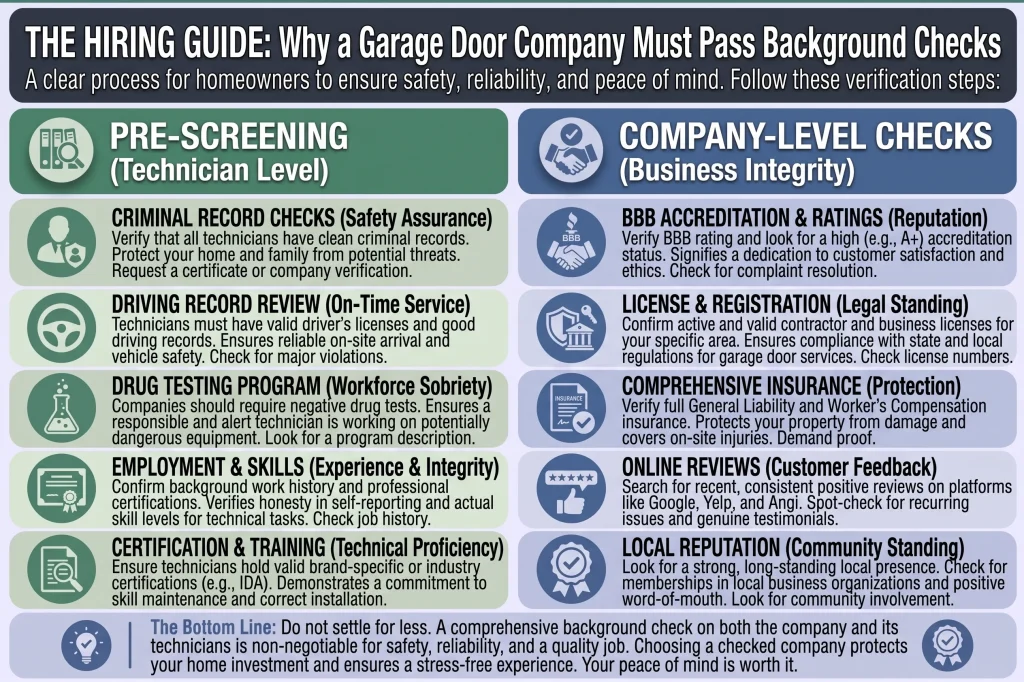
A company that passes every step of this checklist rarely leaves a homeowner with an inflated bill or unfinished work, since verified licensing and transparent pricing tend to go hand in hand. Time spent vetting protects both the household budget and the safety of everyone living in the home.
C&C Garage Door and Opener LLC has spent years helping homeowners throughout Jefferson, Georgia, confirm licensing and pricing details before any technician steps onto the property. Contact us or give us a call today, and let our team show you what proper documentation looks like before you commit to anything.